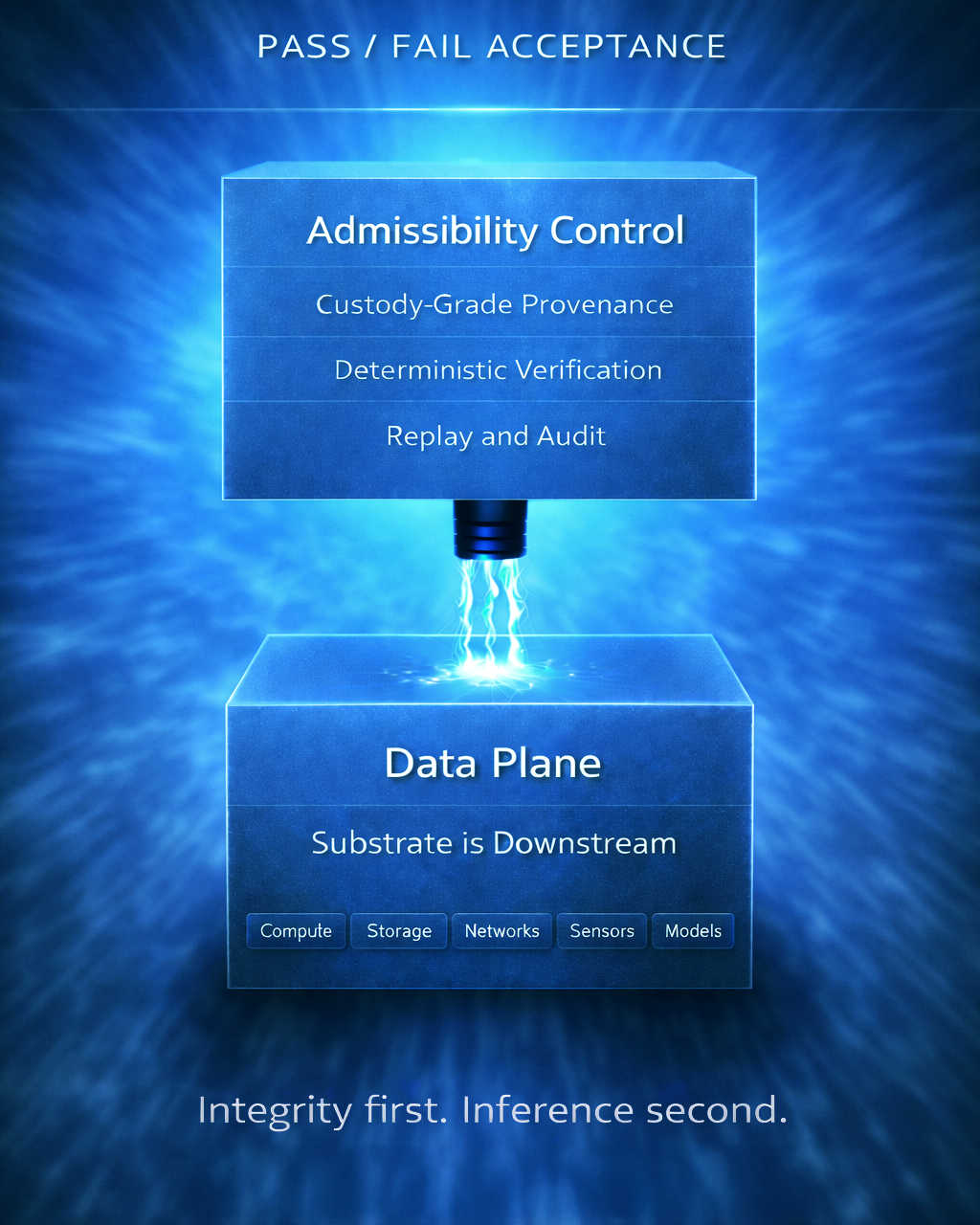
Admissibility Control Plane

Turns trust into proof.
Independent verification without vendor dependency.
two-step predicate

Step 1: Integrity First

Step 2: Inference Second

1. Capture-time sealing, deterministic segmentation, chain continuity, signed manifest.

2. Model identity, runtime identity, input binding, provenance graph, deterministic output encoding.

You only win legally if replay and audit are independently verifiable.

Conformance classes

Class A - Class E

Minimum required:
Class A + Class C.

If AI analytics are in scope, Class B is required.

If multiple sensors must be correlated, Class D is required.

Class A: Capture Integrity (C1 to C9)

Class B: Inference Provenance (I1 to I10)

Class C: Replay and Audit (R1 to R10)

Class D: Multi-Feed Orchestration (M1 to M8)

Class E: Operational Security (S1 to S10)
bidder responses

Show me. Exactly. Independently.

Required Responses:

  • Conformance class declaration
  • Architecture mapping to each control
  • Sample Evidence Package structure and sample verification report format
  • Verifier tooling availability and offline capability statement
  • Key management policy summary
  • Determinism statement for segmentation, replay, and inference artifacts
download control plane pdf

Acceptance tests:

AT1 Byte flip: verification fails

AT2 Missing segment: verification fails and reports missing content

AT3 Reorder: chain verification fails

AT4 Replay consistency: two systems match timeline boundaries

AT5 Inference trace: output traces to exact input segment digests

AT6 Offline verification succeeds

AT7 Key rotation still verifies older packages

AT8 Multi-feed alignment reproduces across independent machines
RELEASE GATE

A deterministic PASS/FAIL gate for ML model releases, with receipts that can be independently verified later.

Release Gate turns your internal readiness criteria into a release decision that survives review after the fact.

What can be gated:
  • Model build release
  • Dataset release
  • Capture integrity release
  • Export integrity release

What you get:

Release Certificate (PASS/FAIL + gate ID + run ID)

Offline Release Report (self-contained HTML)

Updated package (validated receipts + manifests)

How it works

1. Gate definition:
Customer-owned PASS/FAIL criteria for a specific release boundary.

2. Customer-run execution:
Run on your compute, inside your environment.

3. Receipt return:
Send the minimum receipt bundle, sanitized by default.

4. Loko validation:
Receipts are validated against the approved gate.

5. Re-verifiable return package:
You receive a package any authorized reviewer can verify offline.


Release Gate certifies provability and integrity controls for the release boundary.

It does not validate general product functionality or end-to-end application behavior.